-
Bachelor Thesis Themes for the Group MTMf-23
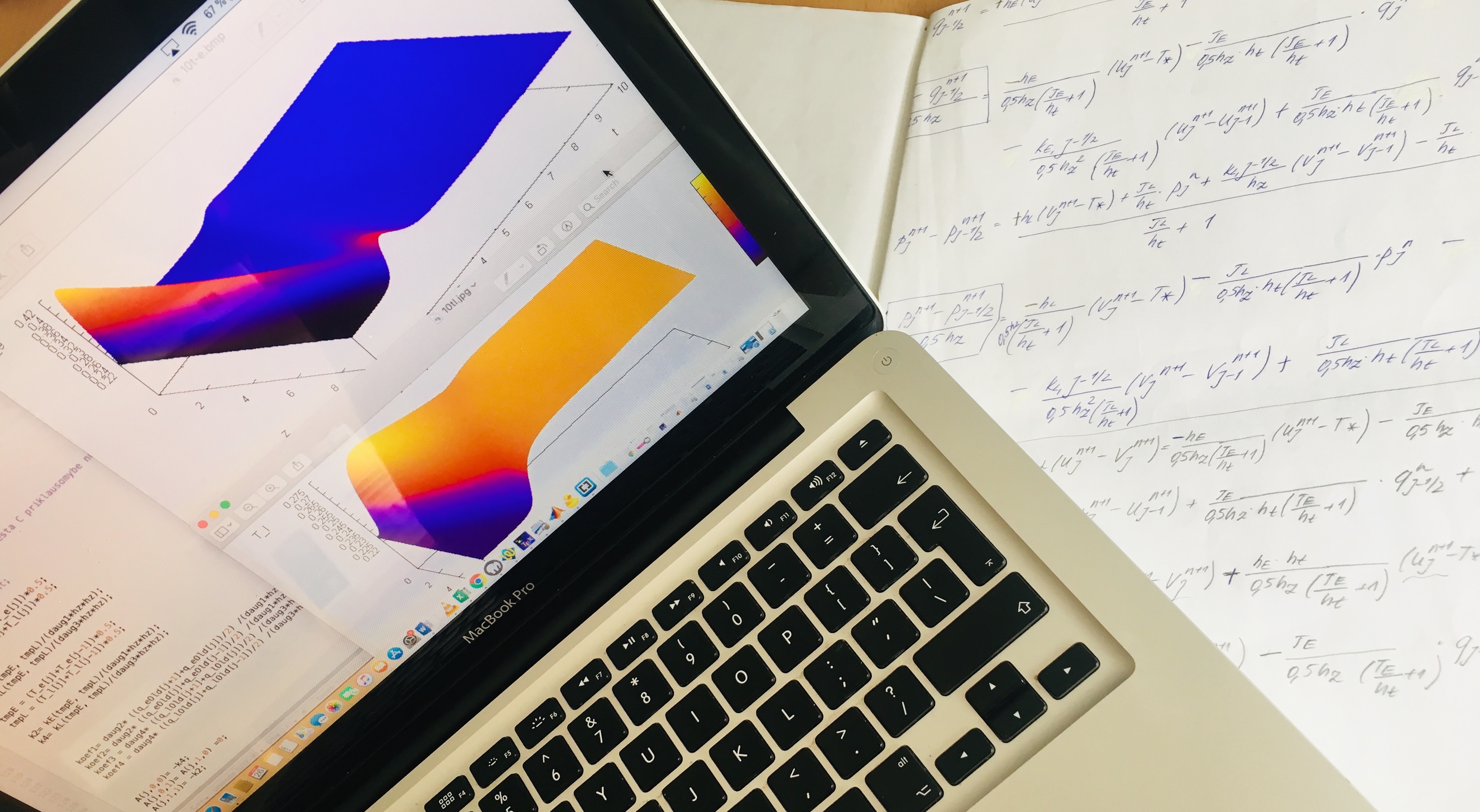
Numerical solution of inverse parabolic problems.
Supervisor
Raimondas Čiegis
Student
Ainius Morkvėnas
Abstract
Many applications in engineering, chemistry, material sciences require to consider processes of heat conduction. Such problems are defined as linear parabolic problems. The first task will be to study popular and not complicated numerical schemes for numerical solution of direct problems. Second task: in many applications it is important to determine the source term f(t), which depends only on time (not on space coordinates) when some additional information about the solution is known from measurements. Your task will be to write first order linear variations of the solution u(x, t; f) and cost functional J(f) with respect to source f. Next You will determine the gradient function J'(f) and will solve the minimization problem by using the classical gradient decent method.
Requirements
1. Basic theory of Algorithms
2. Basic theory of mathematical models
3. Numerical algorithms.
4. Programming in Python or C++.Comparison of algorithms for shortest path problems.
Supervisor
Olga Suboč
Student
Iveta Judėnaitė
Abstract
The amount of data is growing constantly, and we need higher efficiency algorithms to find the shortest paths. There are many classical algorithms, but they often are not suitable for large-scale data processing. Existing algorithms need to be improved and new ones to be created, so investigation of the problem remains one of the popular till nowadays. Some results of these investigations can be found in the articles listed below.
Requirements
Analyze several classical and new algorithms. Select some algorithms for comparison. Write a code and test selected algorithms. Present results, conclusions and recommendations.
-
Bachelor Thesis Themes for the Group MTMfu-23
Investigation of Transfer Learning Effectiveness in YOLO Models on Domain-Specific Image Datasets.
Supervisor
Andrej Bugajev
Student
Halina Vatsenka
Abstract
This bachelor’s thesis will examine the use of transfer learning in YOLO-type deep neural network models for solving object detection tasks on specific, non-MS COCO image datasets. The main goal is to investigate to what extent the use of pre-trained weights (e.g., trained on the MS COCO dataset) improves YOLO model performance compared to training from scratch for a chosen narrow domain. To achieve this goal, the following main tasks are planned: 1. Review YOLO model architectures and transfer learning methods used for object detection. 2. Review freely available domain-specific image datasets (other than MS COCO), select one or several for the study, and prepare them for experiments (annotations, data splitting, preprocessing). 3. Formulate the object detection task and design an experimental setup: training YOLO models with transfer learning (using pre-trained weights) and without it, under comparable conditions. 4. Analyze and compare the obtained results: accuracy metrics (e.g., mAP, precision, recall), possible differences under varying amounts of training data, and draw conclusions on the effectiveness of transfer learning for the selected domain.
Requirements
Good Python programming skills; basic knowledge of deep learning and neural networks; ability and willingness to read documentation for YOLO and related libraries (e.g., PyTorch, etc.). Access to a GPU or other accelerated computing environment for model training is desirable. The expected outcome is an analysis with conclusions on the impact of transfer learning on YOLO model accuracy for the selected datasets, as well as a fully functioning Python program for model training and performance evaluation.
Mathematical Modelling of Memristors and Their Role in Neuromorphic Computing.
Supervisor
Jevgenijus Kirjackis
Student
Gleb Mokhov
Abstract
Memristors are nonlinear circuit elements whose resistance depends on the history of applied signals. They form the basic building blocks of many neuromorphic and compute-in-memory architectures, where large crossbar arrays perform analog matrix operations. The thesis focuses on the mathematical modelling of individual memristors using nonlinear differential equations with internal state variables and on the analysis of simple memristor-based computational structures. Numerical simulations will be used to study model behavior, parameter sensitivity, and basic neuromorphic operations such as matrix–vector multiplication.
Requirements
Knowledge of ordinary differential equations and nonlinear dynamical systems. Familiarity with numerical ODE methods. Ability to perform numerical experiments in MATLAB or Python. Basic understanding of matrices and linear algebra in applications.
Customer Churn Prediction in Telecommunications Using Machine Learning Method.
Supervisor
Rima Kriauzienė
Student
Oleksandr Tetyukhin
Abstract
This bachelor's thesis examines the problem of customer churn prediction in the telecommunications sector. The main goal is to develop and evaluate machine learning models for customer churn prediction on one or more publicly available telecommunications churn datasets, and to compare the performance of traditional models with modern gradient boosting and other recent machine learning libraries (e.g., XGBoost, LightGBM, CatBoost). To achieve this goal, the following main tasks are planned:
1. Review publicly available telecommunications customer churn datasets, select one or several for the study, and prepare them for analysis.
2. Review machine learning methods and Python libraries for classification, including widely used tools and newer frameworks (e.g., gradient boosting libraries).
3. Formulate the churn prediction task, preprocess the data, and implement several classification models using different libraries.
4. Analyze and compare the obtained results using accuracy and other evaluation metrics, investigate feature importance, and draw conclusions on the effectiveness of the selected methods and libraries for churn prediction.Requirements
Python programming skills; knowledge of machine learning and classification (train/test split, evaluation metrics, overfitting, etc.); ability and willingness to read documentation for Python data analysis and machine learning libraries (e.g., pandas, scikit-learn, XGBoost, LightGBM, CatBoost or similar frameworks).
Mathematical modelling of zooplankton dynamics.
Supervisor
Terese Leonavičienė
Student
Sofiia Nikitenko
Abstract
Climate change issues are often discussed and analyzed at different levels. Various resolutions are adopted for slowing down the change in the environment around us. In order to better understand the processes that change aquatic flora and fauna, we need to find convenient tools that allow us to analyze and assess the dynamics of various populations, predict possible scenarios. The bachelor thesis focuses on mathematical models of phytoplankton and zooplankton dynamics. After reviewing the models, it is planned to perform a detailed analysis of the selected zooplankton dynamics model.
Requirements
The work is based on the analysis of systems of differential equations. The knowledge regarding differential equations and dynamic systems are required.